

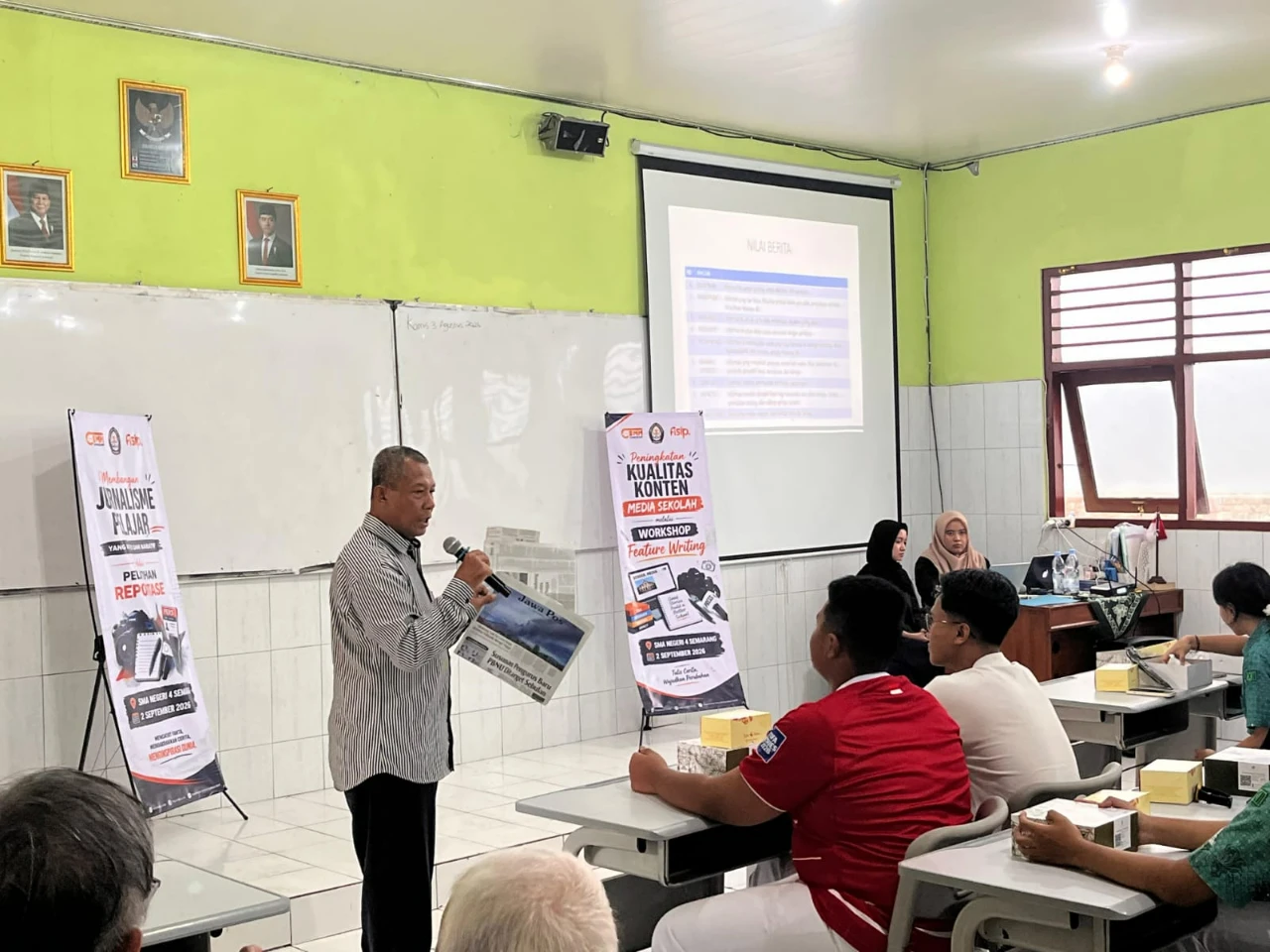
SEMARANG — The team of lecturers from the Department of Communication Science, FISIP Undip, held a journalism training for students of SMA Negeri 4 Semarang on Wednesday (September 2). This activity served as a space for students to learn about the journalistic process while developing their ability to process information into critical, factual, and engaging works.
Carrying the theme “Building Critical and Narrative Student Journalism,” the training featured four Communication Science lecturers from Undip: Dr. Sunarto, M.Si., Dr. Adi Nugroho, M.Si., Drs. Joyo Nur Suryanto Gono, M.S., and Drs. Wiwid Noor Rakhmad, M.I.Kom. The four lecturers explored various aspects of journalism, ranging from the reporting process, news writing, to the development of feature articles closely related to student life.
The first session was delivered by Dr. Sunarto, M.Si., discussing the development of journalism amidst technological changes and shifts in public information consumption patterns. According to him, the journalistic process still requires field reporting so that the information obtained can be directly verified.
In addition to discussing the importance of reporting, Dr. Sunarto introduced the concept of in-depth reporting as an approach to digging deeper into information. He also explained that the development of digital media requires journalists to understand how to present information in various formats, such as text, photos, video, and interactive media.
The next session was delivered by Dr. Adi Nugroho, M.Si., focusing on reporting techniques and news writing. Using a printed newspaper as a learning medium, the lecturer, popularly known as Mas Adi, invited students to directly recognize the structure and characteristics of journalistic writing in the media. Dr. Adi showed and explained, for example, why the eruption of Mount Sinabung became a headline in mass media.
The students of SMA 4 were introduced to various types of writing in mass media, the stages of reporting, and the concept of news value. The material also covered the basics of scriptwriting and the use of effective journalistic language. In news writing, Mas Adi emphasized the importance of the 5W+1H elements—what, who, when, where, why, and how—as a basis for ensuring that the information conveyed can be fully understood by readers.
The next speaker, Drs. Joyo Nur Suryanto Gono, M.S., delivered material on feature writing for school media. He explained the difference between straight news, which prioritizes direct factual reporting, and feature writing, which provides more space for storytelling, atmosphere, and the human side of an event.
In this session, students were also introduced to the principle of “show, don’t tell.” This principle encourages writers to depict an event through details, atmosphere, and character experiences so that readers can visualize the story more clearly. This approach can be applied to school articles that are not only informative but also have narrative appeal.
The fourth session was delivered by Drs. Wiwid Noor Rakhmad, M.I.Kom., who discussed the human interest element in feature writing. He invited students to look at their surroundings as a source of journalistic stories. Student experiences, school activities, inspiring stories, and issues close to teenagers’ lives can be developed into writing that holds value for readers.
The human interest approach also serves as a way to make school media more relatable to its readers. By highlighting real experiences and stories relevant to everyday life, students can produce works that not only convey information but also build an emotional connection with readers.
The participants enthusiastically followed all sessions. The training was attended by 39 students. Not only gaining an understanding of journalism theory, students also gained insight into how information is collected, verified, processed, and presented to the public.
Through this activity, students’ journalistic skills are expected to be continuously developed through practice in the school environment, whether through wall magazines, bulletins, or digital media. This training, which is part of the community service program of the Department of Communication Science, FISIP Undip, is also a step toward encouraging the emergence of student journalists who are able to critically observe issues around them, conduct reporting responsibly, and tell stories in creative and meaningful ways.
In previous community service activities, similar training was also held at SMA Negeri 1 Semarang last semester. The training was intended for the managers of the school magazine/media of SMA 1 Semarang.